

Glass Block Basement Windows: Patterns, Vents, and Fit

Updated: Aug 20
Glass Block Basement Windows: Patterns, Vents, and Fit
Once you've decided on glass block, the questions change. What pattern? Can it still vent? Will it fit an opening that isn't square?
Here's what those choices actually look like.
Legacy Glass Block & Window Co. has installed glass block across Will, Cook, and DuPage counties since 1986.
Patterns for Glass Block Basement Windows
The pattern determines how much you see through the panel and how the light lands inside.
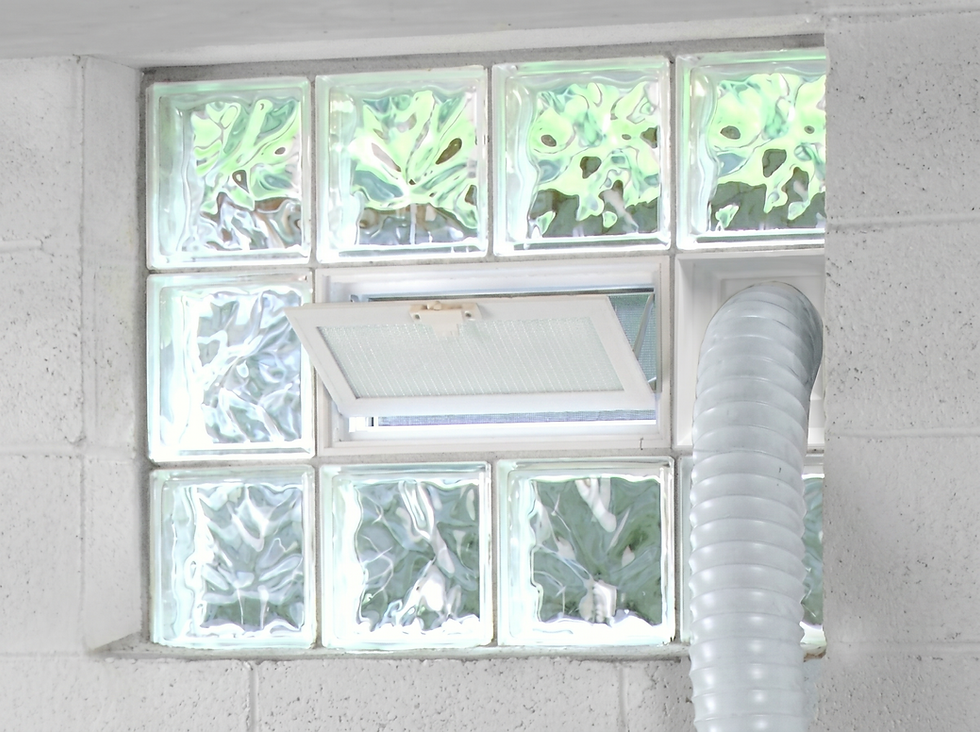
IceScapes. The standard for basements — a wavy, textured face that passes daylight while breaking up the view completely. From outside it reads as frosted; from inside you get light without a sightline. This is what most basement openings get.
Clearer patterns exist for spaces where you want more visibility, though they're uncommon below grade — most people choosing glass block are choosing it partly for privacy.
Pattern affects light, not strength. A panel is a panel regardless of face texture.
Vents
A solid panel closes the opening tight, which is what you want for security and heat loss but not always what you want for air.
Hopper vent. A small screened section built into the panel that opens and latches shut. Utility rooms and finished basements usually get one; storage areas and street-facing openings usually don't.
Dryer vent. If your dryer exhausts through a basement window, the port is built into the panel and the duct runs straight out through a sealed opening — not cut in afterward, so there's no gap around the duct.
Bathroom openings. Glass block handles humidity well, which is why it holds up in basement bathrooms where a wood sash wouldn't.
You decide vent placement opening by opening. There's no requirement to treat them all the same.
Fitting Old Openings
This is where basement work differs from ordinary window replacement.
Foundations settle. Openings that were square in 1965 usually aren't now, and almost no two on the same house match.
Every opening gets measured on site rather than ordered from a standard size. The panel is built to what's actually there, then mortared and sealed into the opening.
If the old frame is failing, it comes out. If it's sound, we work with it. We confirm which when we measure.
What Glass Block Basement Windows Change
Drafts. Old steel hoppers leak air at the seal, the latch, and the frame corners. A mortared panel has none of those — no sash seams, no weatherstripping to fail, nothing to re-caulk in five years.
Security. Basement openings sit low and are often screened by landscaping. A mortared panel has no sash to pry and no frame to lever, so getting through takes sustained, loud, obvious effort.
Daylight. A dark basement reads as unfinished. Obscure block brings the light in without opening the room to the street.
Water at the opening. A panel closes the gaps where water was getting in around a rotted frame. It is not basement waterproofing — most basement water comes through walls and slab, and that's a different trade.
What to Expect
Legacy Glass Block & Window Co. is family-owned and has served Will, Cook, and DuPage counties since 1986.
Our own crews do the work, no subcontractors, and basement glass block openings are finished in a single day. Every installation is backed for as long as you own your home.
See patterns, pricing, and recent projects on our Glass Block Windows page, or call (708) 247-2044 for a free estimate.


Comments